




A Minimally Invasive Treatment Option for Prostate Enlargement
Frequent urination? Difficulty starting? Weak urine flow? Waking several times at night to urinate?
These could be symptoms of an enlarged prostate, also known as Benign Prostatic Hyperplasia (BPH).
At MIOT International, Prostatic Artery Embolization (PAE) offers selected patients with BPH a minimally invasive, non-surgical treatment option. Performed by an Interventional Radiologist through a tiny catheter, PAE works by reducing the blood supply to the enlarged prostate, allowing it to gradually shrink and helping relieve urinary symptoms.
The prostate is a gland located below the bladder and surrounds part of the urethra – the tube through which urine leaves the body. As men grow older, the prostate can increase in size. The non-cancerous enlargement of Prostate is known as Benign Prostatic Hyperplasia (BPH). As the prostate enlarges, it can compress the urethra and interfere with the normal flow of urine from the bladder. This can lead to bothersome urinary symptoms that may gradually affect sleep, daily activities and overall quality of life. BPH is not prostate cancer. However, because some urinary symptoms can occur with several prostate conditions, proper evaluation is important before treatment.
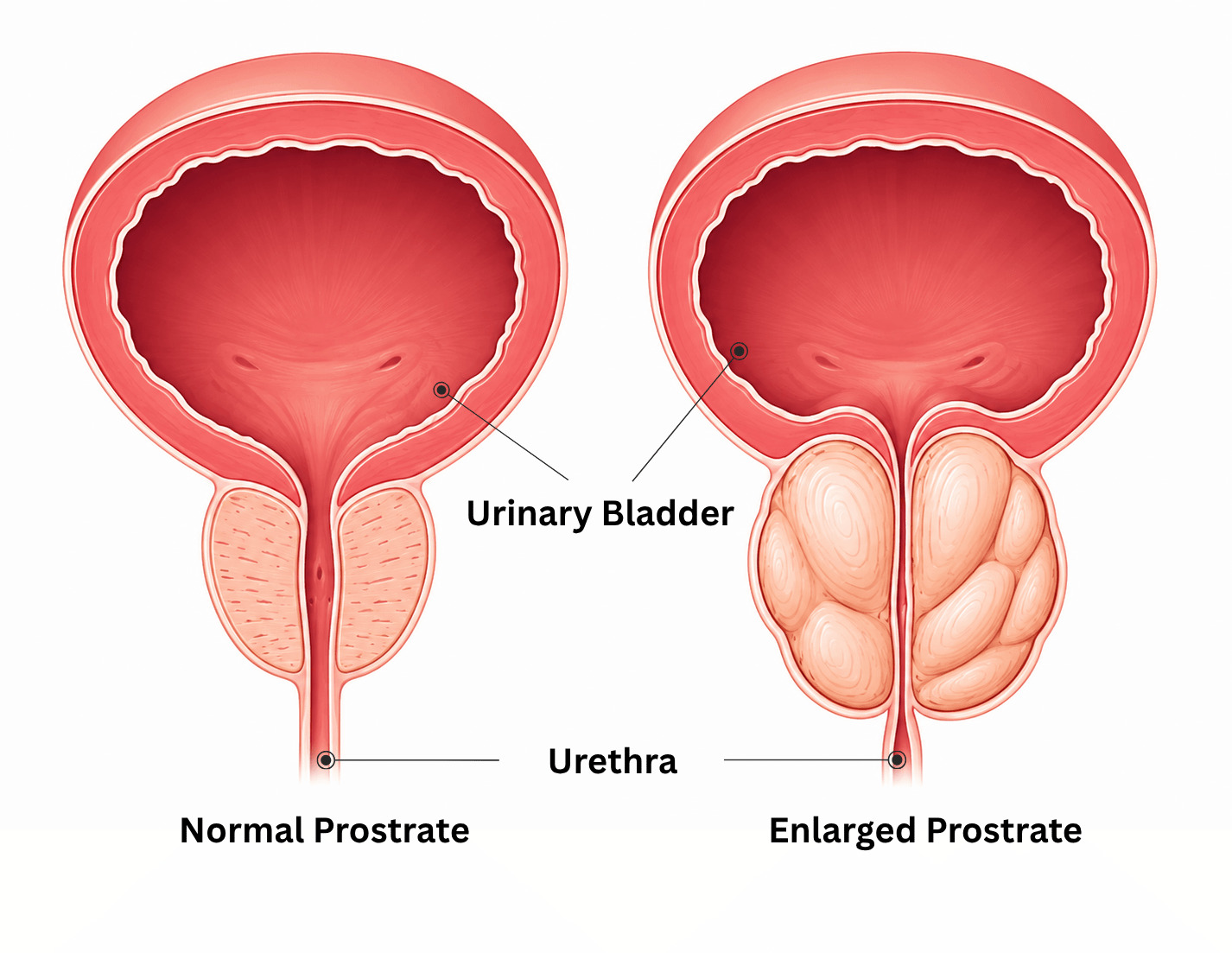

An Enlarged prostate may cause:
Frequent need to urinate
Waking several times at night to urinate
Sudden or urgent need to urinate
Difficulty starting urination

Weak or slow urine stream
Stop-and-start urine flow

Straining while urinating
Feeling that the bladder has not completely emptied
Dribbling after urination

Urine leakage in some patients
Persistent or worsening urinary symptoms should be evaluated rather than simply accepted as part of aging.
And when such symptoms become significant or do not improve adequately with medication, additional treatment options may need to be considered.
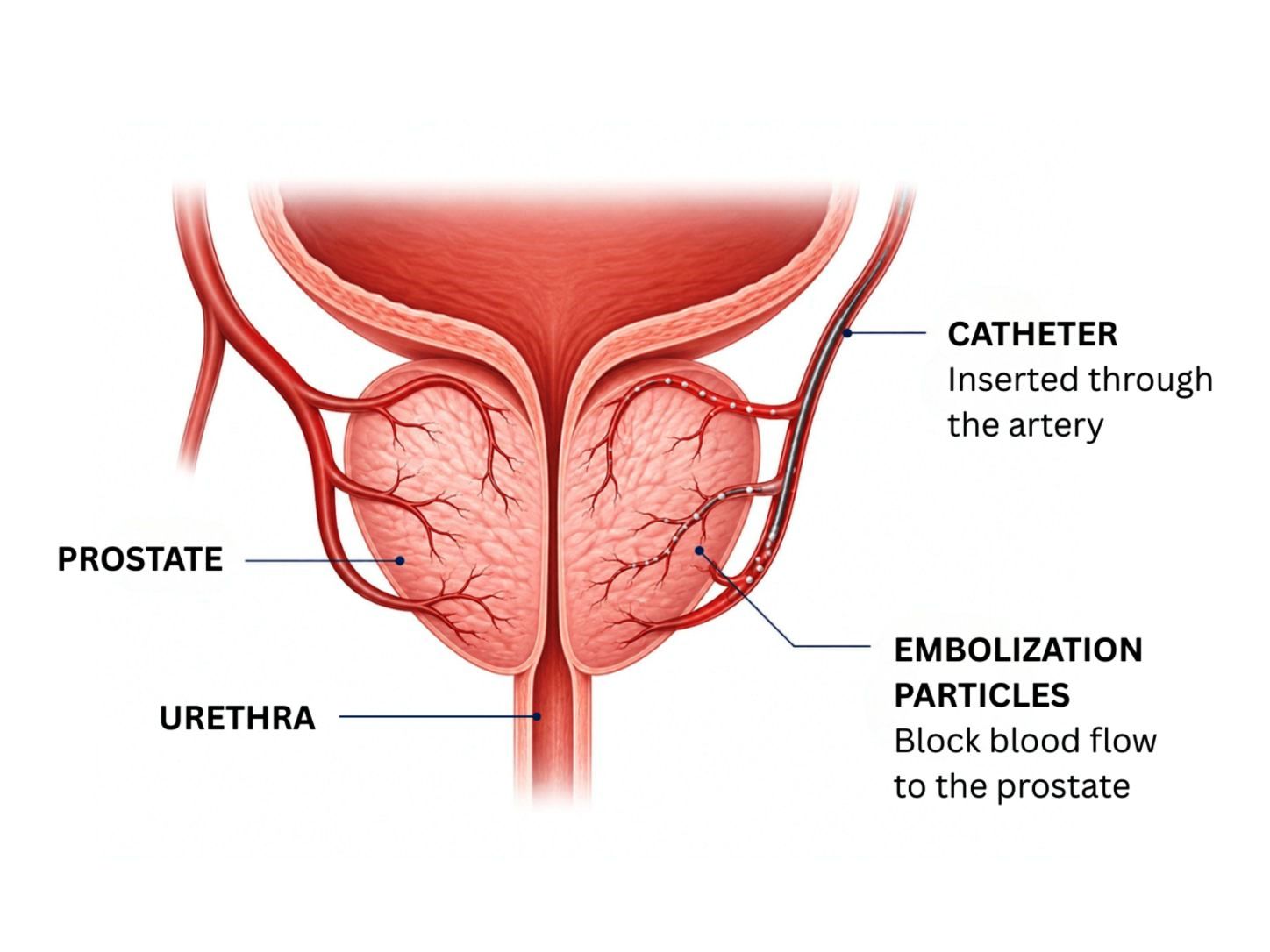
Prostatic Artery Embolization (PAE) is a minimally invasive procedure used to treat urinary symptoms caused by Benign Prostatic Hyperplasia in appropriately selected patients. Unlike conventional prostate surgery, PAE does not require surgical removal or cutting of prostate tissue. Instead, an Interventional Radiologist introduces a thin catheter into an artery, navigates it under image guidance to the arteries supplying the prostate and delivers tiny embolic particles.
These particles reduce blood flow to selected areas of the enlarged prostate. Over time, the treated prostate tissue shrinks, reducing pressure on the urethra and helping improve urinary symptoms.
PAE may also help preserve sexual function, which can be affected by some conventional surgical treatments for prostate enlargement.
A small puncture is made, commonly through an artery in the wrist or groin, depending on the patient's anatomy and the approach selected by the Interventional Radiologist.
Using advanced imaging (Biplane CathLab), a very thin catheter is carefully guided through the blood vessels towards the arteries supplying the prostate.
The Interventional Radiologist precisely identifies the arteries responsible for supplying blood to the enlarged prostate.
Tiny medical particles are delivered through the catheter to reduce blood flow to the targeted prostate tissue.
Following embolization, the prostate gradually decreases in size. As pressure around the urethra reduces, urinary symptoms may improve over time.
Patients are usually discharged in a day or 2 based on their age and symptoms. PAE does not make the prostate shrink immediately. The reduction occurs gradually after its blood supply has been reduced. Improvement in urinary symptoms therefore develops over time rather than immediately after the procedure.
For appropriately selected patients, PAE offers a different approach to treating BPH.
 Reduced Recovery Time
PAE may be considered for men who:
Both PAE and surgical procedures can be used to treat BPH, but they work differently.
| Prostatic Artery Embolization | Conventional Surgical Treatment |
|---|---|
| Minimally invasive | Surgical/endoscopic procedure |
| Performed through an arterial puncture | Accesses the prostate through a surgical or endoscopic approach |
| No surgical removal of prostate tissue | May remove, cut, vaporise or enucleate prostate tissue depending on procedure |
| Performed by an Interventional Radiologist | Performed by a Urologist |
| Generally shorter recovery | Recovery varies according to procedure |
| Helps Preserves Sexual function | Can cause Retrograde ejaculation and erectile dysfunction |
| Suitable for selected BPH patients | Several surgical options are available depending on prostate size and condition |
The appropriate approach depends on prostate size, severity of symptoms, bladder function, anatomy, other medical conditions and individual treatment priorities.
At MIOT International, patients with prostate enlargement are evaluated to determine the cause of their urinary symptoms and identify the most appropriate treatment.
Care can bring together expertise from Urology, Interventional Radiology, Radiology and other relevant specialties, enabling patients to be assessed for both conventional and minimally invasive treatment options.
For patients suitable for Prostatic Artery Embolization, MIOT's Interventional Radiology team uses advanced image guidance and catheter-based techniques to precisely target the arteries supplying the enlarged prostate.
If you are frequently looking for a restroom, waking repeatedly at night, struggling with a weak urine stream or experiencing dribbling after urination, it may be time to have your prostate evaluated. Prostatic Artery Embolization (PAE) may offer selected patients with BPH a minimally invasive alternative to conventional surgical treatment.
 CONNECT MIOT